Fascia
This document is strictly confidential.
Unauthorised access, copying, or distribution is prohibited.
Please enter the access code to continue.
© 2026 Mudit Dubey. All rights reserved. Do not share.

The health data layer
that connects everything.

A patient-controlled health identity layer that bridges disconnected NHS systems. One token. Distributed access. Real-time clinical data at point of care.

13.5M
clinician hours lost/year
BMA 2023
1.83M
medication errors at transitions
Li et al. BMJ 2025
75%
of 'lost' patients harmed
Healthwatch 2025
We've digitised the nodes, not the connections

94% of NHS trusts have electronic patient records. All 42 ICBs have shared care records. The NHS App had 62.3 million logins in November 2025 alone. Yet the system still fails patients at every transition point.

45%
NHS services lack any digital pathway
DSIT/Bain & Co, Jan 2025
82%
GPs can't access hospital data regularly
BMA 'Getting IT Right', 2023
25.6%
Median clinical safety compliance
JMIR, 2025 (239 orgs)
3 deaths
Linked to IT failures (31 trusts)
BBC FOI, May 2024
The Referral Black Hole
Healthwatch found 14% of GP referrals vanish — lost, rejected, or never followed up. 75% of affected patients suffered physical or mental health harm. 70% discovered the failure only by chasing it themselves. 200,000+ medical letters unsent due to IT failures across 21 trusts.
Transition Medication Errors
1.83 million undetected transition medication errors per year in England alone, causing harm across ~31,604 patient episodes. 52% occur at hospital admission — exactly the point where a unified patient record would catch them. HSSIB confirms patients are dying from electronic communication failures at discharge.

The Darzi Report (Sep 2024) declared the NHS is "in the foothills of digital transformation." The PM pledged a "digital NHS." But the last time government tried this — the NPfIT (2002) — it cost £12.7 billion and was abandoned. The Health Foundation estimates full digitisation needs £21 billion over 5 years, more than double the £10bn committed.

Patient-controlled. Distributed. Vendor-neutral.
Patient holds the key
QR-based identity token authenticated via NHS Login. Patient decides who sees what. Like Covid vaccine passes — but for your entire health record.
Distributed, not centralised
Data stays where it lives. Fascia is the access layer, not the database. FHIR R4 APIs pull real-time records. No data lake.
15 seconds to unified view
From QR scan to structured clinical summary — medications, allergies, conditions, procedures, discharge notes. Safety data highlighted.
Roads, not Google Maps
EPR vendors build roads. Fascia is the navigation layer on top. Complementary, not competitive. Works with Oracle, InterSystems, Better, System C — all of them.
Why "Fascia"?

Named after the connective tissue that holds the body together.

In anatomy, fascia is the continuous web of tissue that connects every muscle, organ, and nerve. Without it, individual organs function in isolation. With it, the body works as one system.

The NHS has the same problem. Hospitals, GPs, community services — all have digital records. But they're isolated. No connective layer. Patients fall through the gaps.

Fascia is that missing layer. It connects everything — without replacing anything.

The name also reflects the founder's background: a PhD in Tissue Engineering and 9 years in medical devices. Literal, functional, instantly recognisable to clinicians.

GP Hospital Specialist MentalHealth Comm-unity Pharmacy FASCIAconnective layer
The connective tissue  The connective tissue  The connective tissue  The connective tissue  
Technical architecture

How it works — the 60 second version.

PATIENT LAYER Patient QR TokenNHS Login OIDC Consent MgrGranular control NHS App Web Portal Private Providers FASCIA — THE CONNECTIVE LAYER FHIR RouterUK Core R4 Record LocatorNRLS Integration Data NormaliserSNOMED CT / dm+d Audit LoggerDSPT Compliant Safety EngineDCB0129 Analytics PROVIDER SYSTEMS — DATA STAYS HERE GP Connect Oracle Health InterSystems Better/openEHR System C Community/MH STANDARDS & COMPLIANCE FHIR UK CoreSNOMED CTDCB0129DTACDSPTUK GDPRISO 27001
STEP 01
Patient presents QR token
Authenticated via NHS Login (OIDC). Works via NHS App or standalone portal.
STEP 02
FHIR API calls triggered
FHIR R4 calls to GP Connect, hospital EPRs, community services. UK Core profiles.
STEP 03
Distributed data retrieval
Data stays where it lives. Real-time composite. Patient controls consent per-provider.
STEP 04
Clinician sees unified record
Structured, time-sorted summary. Safety data highlighted. Full audit trail. ~15 seconds.
Doctor with tablet
"We're not building a database. We're building an access layer. Data stays where it lives — we just make it findable."
Competitive landscape

Nobody owns the patient-controlled layer. That's where we sit.

PlayerTypeScaleModelCritical gap
FasciaPatient health passportPre-launchPatient-initiated✓ Our space
Patients Know BestPersonal health record5.6M usersProvider-deployedCan't self-aggregate
Epic MyChartPatient portal10+ NHS trustsVendor-lockedEpic-only. No GP data
NHS AppNational platform62M logins/moGovernment-builtGP only. Read-only. SPR 2028+
Oracle HealthEPR vendor25% NHS marketInstitutionalNo cross-vendor portability
InterSystemsIntegration engine~60% of trustsBackendNo patient-facing layer
Better (openEHR)Vendor-neutral CDRScotland NDPTrust-deployedNot patient-initiated
OneRecord (US)Record aggregatorUS onlyFHIR-basedVaccination-focused. No UK
Apple HealthConsumer app2 UK trustsConsumer deviceMinimal NHS integration
£10 billion committed. Architecture undecided.
£10B
NHS digital commitment
HM Treasury, June 2025
$665M
UK patient portal market by 2030
Grand View Research
19.6%
CAGR — fastest in Europe
Grand View Research
£4.1B
NHS trust IT spend (2024/25)
FHI
£6.8B
Projected by 2028/29
FHI Forecast
2028
Earliest SPR on NHS App
Ten-Year Health Plan
Data (Use and Access) Act 2025 — Royal Assent 19 June 2025
Mandatory IT standards
First time the law extends binding standards from NHS providers to IT suppliers. Accreditation + enforcement.
Smart Data schemes
Open-banking-style data portability. Health sector applications via secondary legislation.
Digital Verification
OfDIA on statutory footing. Trust framework for patient identity — directly enables our QR auth model.
Revenue model

Four revenue streams, phased by market readiness.

PHASE 1 — NHS TRACTION
ICS / Trust SaaS licensing
Per-patient-enrolled licensing. Start with inter-trust elective care transfers — clearest ROI.
~£2–5 per patient/year
PHASE 2 — FAST REVENUE
Private provider connections
Per-connection fee for private hospitals, clinics, pharmacies. Faster procurement than NHS.
£500–2,000/provider/month
PHASE 3 — VERIFICATION
Insurance & verified access
Insurers pay per-verification for consent-based patient history access.
Per-verification fee
PHASE 4 — HIGH MARGIN
Population health analytics
Anonymised, consented data insights for ICS commissioning and pharma real-world evidence.
Data licensing model
Roadmap

Antler residency to first pilot. Then scale.

WEEK 1
Discovery & validation
15–20 clinician/CIO interviews. Map workflow breakpoints.
WEEK 2
Technical PoC
QR-authenticated record pull across 2 simulated EPRs. NHS FHIR Sandbox.
WEEK 3
First pilot proposal
Approach 1 ICS for inter-trust elective care. SBRI Healthcare pathway.
WEEKS 4–8
Build MVP
FHIR router + consent engine + safety logging. DSPT registration. DCB0129 Case.
MONTH 3
First NHS connection
1 GP Connect + 1 trust FHIR endpoint. DTAC self-assessment. First real data flow.
MONTH 6
Pilot launch
5-trust pilot. Private provider connections. Insurance verification beta.
MONTH 12
Scale
20+ trust connections. G-Cloud listing. Series A readiness.
UK PATIENT PORTAL MARKET ($M)
2024
$159M
2026
$228M
2028
$383M
2030
$665M

19.6% CAGR · Grand View Research

NHS TRUST IT SPEND (£BN)
2024/25
£4.1bn
2028/29
£6.8bn

+66% growth over 4 years

IDEAL CO-FOUNDER

NHS operations/commissioning background or commercial health-system sales. Understands ICS procurement. Opens doors at trust CIO level.

SWOT — biggest challenges Fascia faces
STRENGTHS
9 years in regulated medical devices — deep clinical safety governance (ISO 13485, 14971, FDA)
Distributed architecture = no central data liability, easier GDPR compliance
Complementary to EPR vendors — reduces acquisition friction
Timing: DUA Act mandates open standards, SPR 3+ years away
Commercial proof: founded Melement, a revenue-generating web agency
WEAKNESSES
Solo founder — needs commercial co-founder with NHS procurement access
No pilot agreement yet — validated by research, not live usage
No codebase — MVP must be built from scratch during residency
Limited NHS commissioning experience — depth is in devices, not procurement
Zero brand awareness — competing for CIO attention vs funded incumbents
OPPORTUNITIES
$665M market by 2030 at 19.6% CAGR — fastest in Europe
DUA Act mandates interoperability → creates demand for connective layers
NHS 10-Year Plan calls for patient-facing SPR by 2028 — Fascia can be what it connects to
Private providers + insurance = faster revenue than NHS. Dual-track de-risk
SBRI Healthcare funded 65 innovations in 2024 at £31.7M
THREATS
NHS App could expand beyond read-only GP records
Epic/Oracle could add cross-vendor features — deepening lock-in instead
Trust procurement cycles are 12–18+ months — runway burn risk
FHIR adoption is patchy — some trusts haven't exposed endpoints
Post-care.data trust deficit — patients may distrust new health data intermediary
Healthcare technology
"Week one with users, week two building, week three selling."
Frequently asked questions

Questions we get asked.

How does this technically work?
+

QR-based token, authenticated via NHS Login (OIDC). Triggers FHIR R4 API calls to connected providers using UK Core profiles.

Data doesn't move. Distributed access — query and display, not copy and store. ~15 seconds to structured summary.

💡 "We're not building a database. We're building an access layer."
Who else is doing this?
+

Nobody owns this space. PKB is provider-deployed. Epic MyChart is vendor-locked. EPR vendors serve institutions. Apple Health stuck at 2 UK trusts.

💡 "Everyone builds for institutions. The patient-controlled layer is unbuilt."
How do you make money?
+

1. SaaS to trusts/ICSs ~£2–5/patient/yr. 2. Private provider connections £500–2k/mo. 3. Insurance verification per-use. 4. Population health analytics licensing.

💡 "NHS for credibility, private for speed, data insights for margin."
Isn't the government already building this?
+

SPR in "test and learn." No architecture decided. Earliest 2028. NPfIT cost £12.7bn and failed.

💡 "A startup can build the patient layer now and become what the SPR connects to."
What about data privacy?
+

9 years under ISO 13485/14971, FDA. Compliance: DSPT, DCB0129, DTAC, UK GDPR. Distributed = we never hold data.

💡 "We hold the key, not the data."
Aren't you competing with EPR vendors?
+

EPR vendors build roads. Fascia builds Google Maps. We make their systems more valuable.

💡 "Complementary, not competitive."
What's your first concrete step?
+

Week 1: 15–20 CIO/clinician interviews. Week 2: Working PoC on NHS FHIR Sandbox. Week 3: First ICS pilot proposal + SBRI application.
💡 "Week one users, week two building, week three selling."
The founder
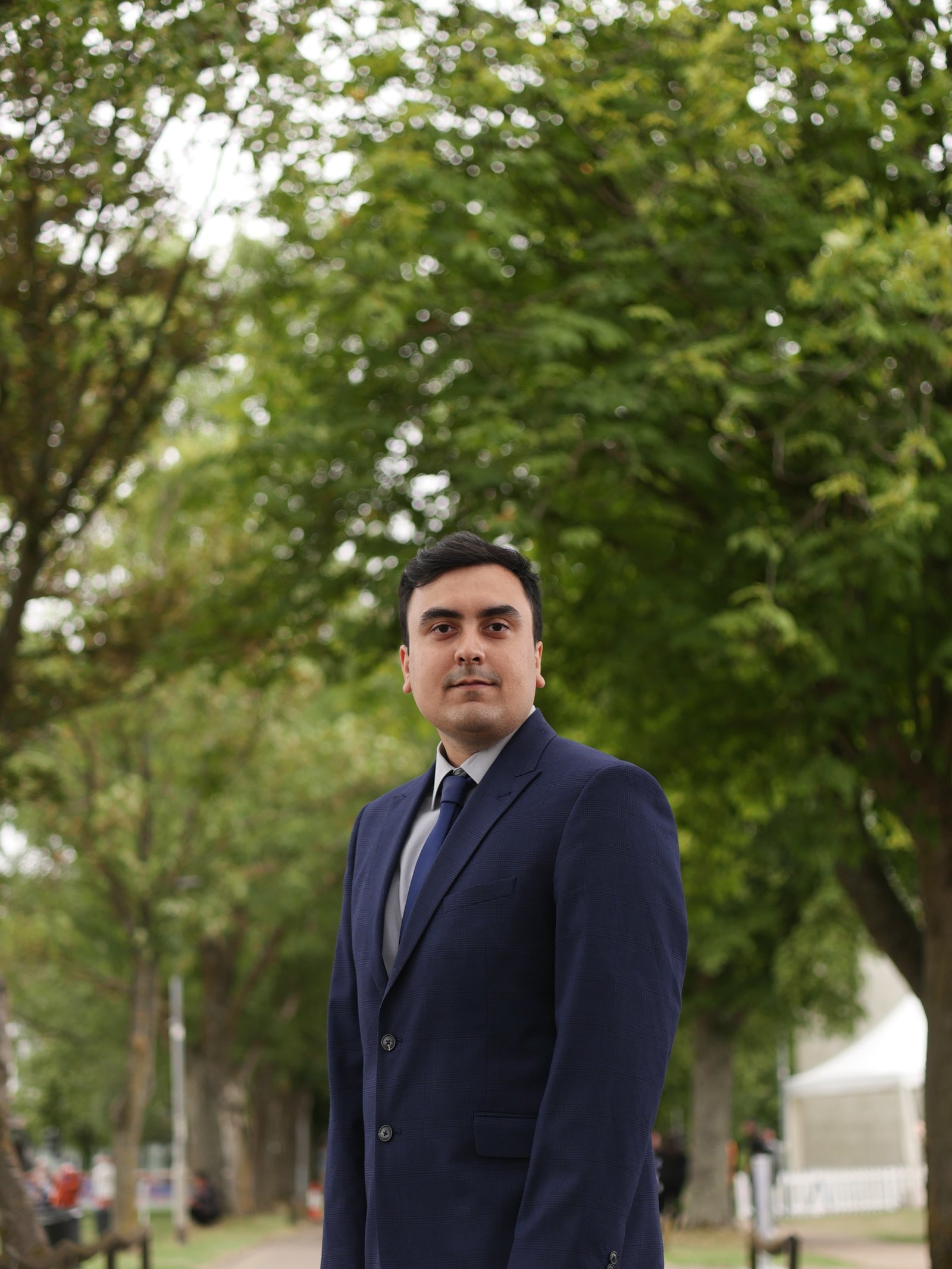
Dr. Mudit Dubey

Mudit Dubey, PhD — 9 years building at the intersection of hardware, software, and clinical systems.

PhD, Tissue Engineering — DePuy Synthes / J&J. Custom biomechanical simulation for chondrolabral hip damage. Published in PLOS ONE. Sole biomedical engineer at Proxisense — melanoma biosensor from concept to NHS trials. 98% measurement improvement.

Senior Systems Engineer — ANGLE Plc. Parsortix — first FDA-approved circulating tumour cell capture. Led FMEA processes, validation, software dev. Founded Melement — revenue-generating web design agency.

"Whether it's a biopsy stuck in a lab, a referral lost between trusts, or a history that doesn't follow the patient — the root cause is the same. We've digitised nodes but not connections. I want to build the connective tissue."— Dr. Mudit Dubey
Confidential — do not copy, share, or distribute — © 2026 Mudit Dubey